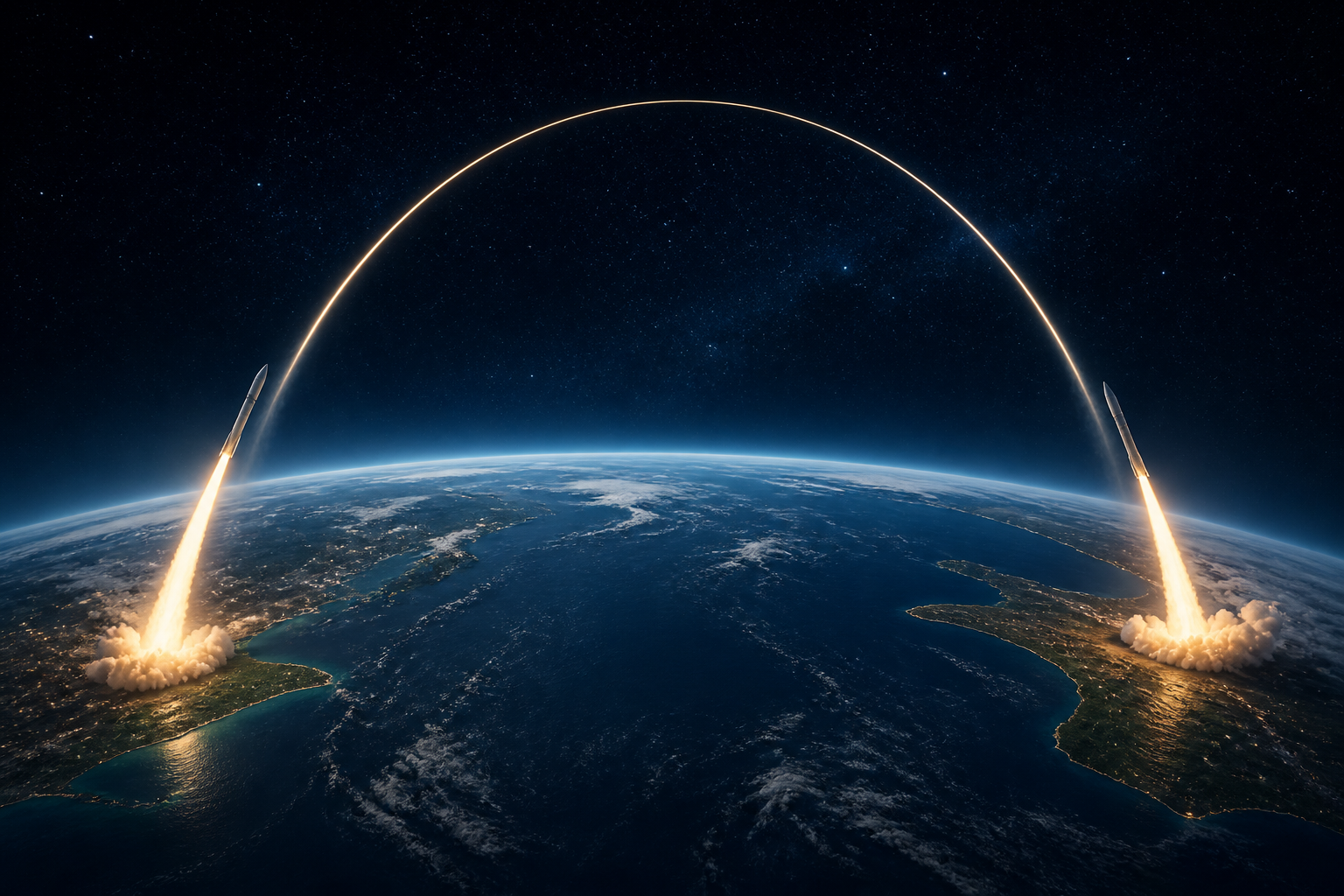
SpaceX is trending after two Falcon 9 rockets lifted off just 38 minutes apart on August 15, 2026, a turnaround that Space.com reported as a new record for the shortest interval between the company’s orbital flights. One launch carried eight Globalstar communications satellites from Florida; the other was the U.S. Space Force’s USSF-366 mission from California. The compressed schedule is striking because it makes two separate launch campaigns look almost simultaneous while still requiring separate rockets, teams, ranges, and recovery plans.
The trend is not really about a single spectacular payload. It is about operational tempo: how often a launch provider can prepare, fly, recover, and move on to the next mission without treating every liftoff as a one-off event. That is a useful distinction for anyone seeing the headlines and wondering what, exactly, the 38-minute figure proves.
What happened on August 15?
The first Falcon 9 lifted off from Cape Canaveral Space Force Station in Florida at 9:12 p.m. Eastern time, according to Space.com. Its mission was Globalstar 2-R Launch 1, carrying eight satellites to low Earth orbit for the communications company Globalstar. A separate Falcon 9 launched USSF-366 from Vandenberg Space Force Base in California at 9:50 p.m. Eastern time, 38 minutes later.
Those are distinct launch sites on opposite U.S. coasts, so the record did not mean that one pad was reused in less than an hour. It meant that two independent launch operations were sequenced with unusually little time between them. Space.com reported successful first-stage landings for both missions. Details about the USSF-366 payload remain limited because it was a national-security flight; that lack of detail is normal for some Space Force missions, not evidence of a problem.
SpaceX’s mission page for Globalstar 2-R Launch 1 describes the basic Falcon 9 sequence: stage separation, the first-stage return, a landing attempt, and a later second-stage burn for satellite deployment. That published flight profile helps explain why a rapid launch cadence depends on more than the countdown clock.
Why 38 minutes caught people’s attention
Rocket launches are public events, but they are also carefully coordinated operations. A launch has to fit a mission’s orbital needs, local weather and safety rules, range availability, airspace and maritime notices, ground crews, propellant loading, and recovery logistics. Two launches occurring close together can therefore be a more intuitive measure of maturity than a larger but abstract annual launch count.
The previous company mark cited by Space.com was two Starlink launches on August 31, 2024, separated by 65 minutes. Beating it by 27 minutes creates a simple, shareable number, which helps explain the surge in searches. It also pairs two missions with very different public profiles: a commercial communications-satellite launch and a mission whose payload information was not broadly released.
What the record does—and does not—show
The record shows that SpaceX coordinated two orbital missions with an unusually short gap. It supports the view that Falcon 9 operations have become highly repeatable, especially because both flights used boosters that had already flown before. Space.com reported that the Florida booster was on its 14th flight and the California booster on its 18th.
It does not mean rockets can be turned around in 38 minutes. Each mission used its own rocket, pad, personnel, trajectory, and recovery arrangement. Nor does it reveal the full cost, environmental impact, or national-security purpose of the missions. A quick pair of launches is an operational milestone, not a complete scorecard for a space program.
That caveat matters because “reusability” can sound like a rocket is immediately ready for another trip after landing. In practice, a recovered first stage must be transported, inspected, maintained, and assigned to another mission. Reuse lowers some barriers to frequent launch, but it does not eliminate the work between flights.
How the two missions fit together
The Globalstar mission had a clear civilian purpose: replenishing a low-Earth-orbit communications network. SpaceX’s mission page identifies the flight as a Falcon 9 launch from Cape Canaveral and lays out the planned deployment sequence. USSF-366, by contrast, was conducted for the U.S. Space Force, and public reporting says little about its payload. The two launches therefore illustrate a broader point about launch providers: the same basic vehicle can support customers with very different disclosure rules.
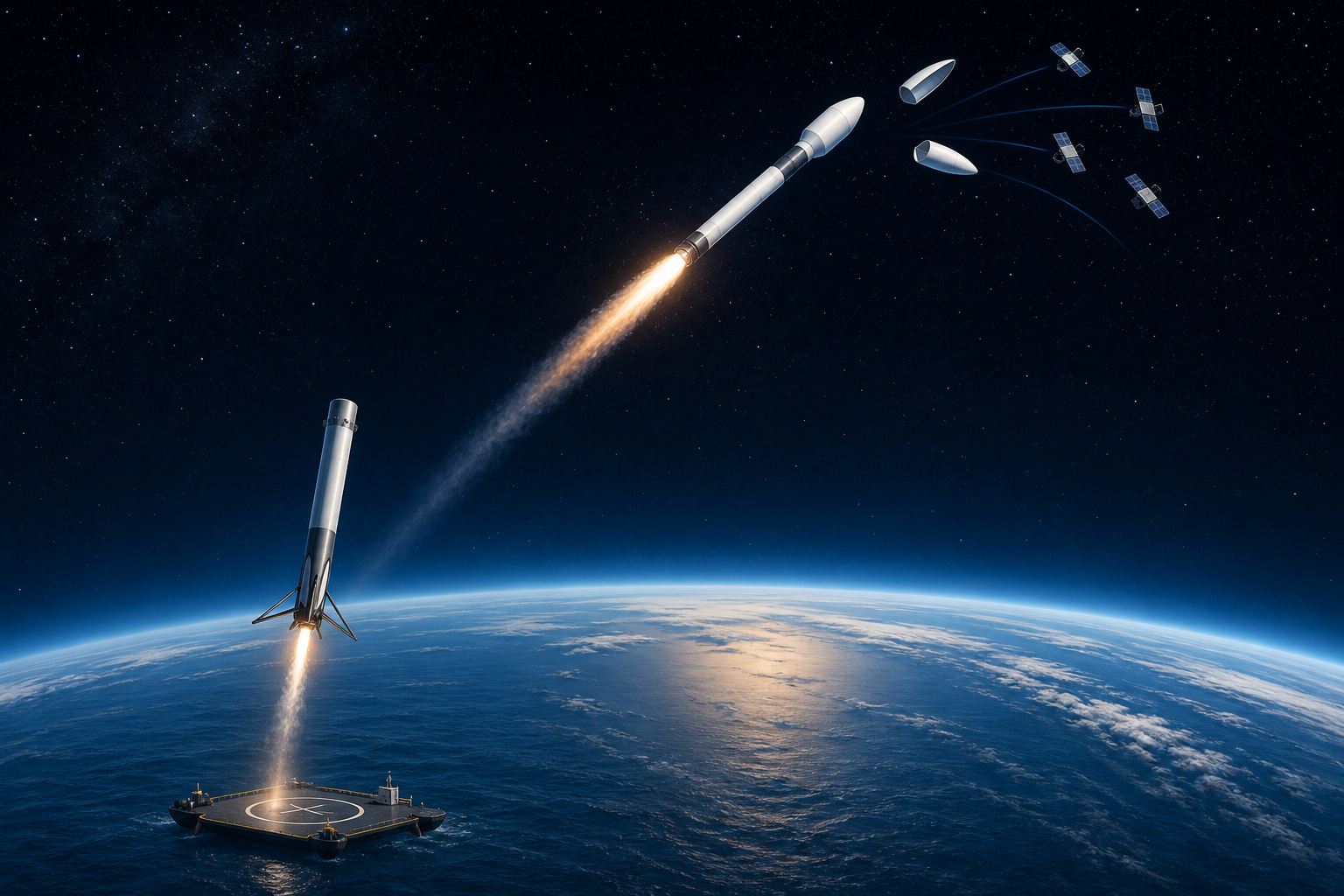
This illustration is conceptual, not a reconstruction of either August 15 mission. It highlights the general sequence that makes a reusable launch system useful: an upper stage continues toward its destination while a first stage returns for recovery. On the actual USSF-366 mission, the publicly available payload details are limited, so readers should avoid treating guesses about its destination or hardware as confirmed facts.
Why launch cadence matters beyond a record
Frequent launches can make it easier for satellite operators to plan replacements, add capacity, or schedule missions that cannot wait for a rare annual window. They can also give governments more options for deploying spacecraft. For the launch provider, a dense schedule is a test of manufacturing, supply chains, launch-site readiness, mission control, and recovery infrastructure—not just the rocket’s engines.
There is a practical limit to what one record can tell us. Weather, customer schedules, range constraints, technical reviews, and the need to investigate anomalies can all slow a launch calendar. A record set on one night does not guarantee a permanent pace. The useful takeaway is narrower: SpaceX demonstrated that, under the right conditions, two orbital launches from separate coasts can be carried out less than an hour apart.
What happens next
The immediate story is the 38-minute interval, but the longer story is whether rapid, repeatable operations become routine across more launch providers and mission types. Future launch schedules will still depend on the needs of customers and regulators, and classified missions will continue to leave some questions unanswered. For now, the verified point is straightforward: two separate Falcon 9 missions launched successfully on August 15, 2026, and the unusually short gap is why SpaceX has become a major search trend.
Sources
- Google Trends Trending Now — the U.S. past-24-hours trend signal that showed heightened search interest in SpaceX.
- Space.com’s report on the August 15 Falcon 9 doubleheader — launch times, the 38-minute interval, booster-flight counts, landings, and the limits of publicly available USSF-366 information.
- SpaceX’s Globalstar 2-R Launch 1 mission page — the published mission profile and general Falcon 9 launch, landing, and deployment sequence.
Last checked: August 17, 2026, 8:35 PM KST