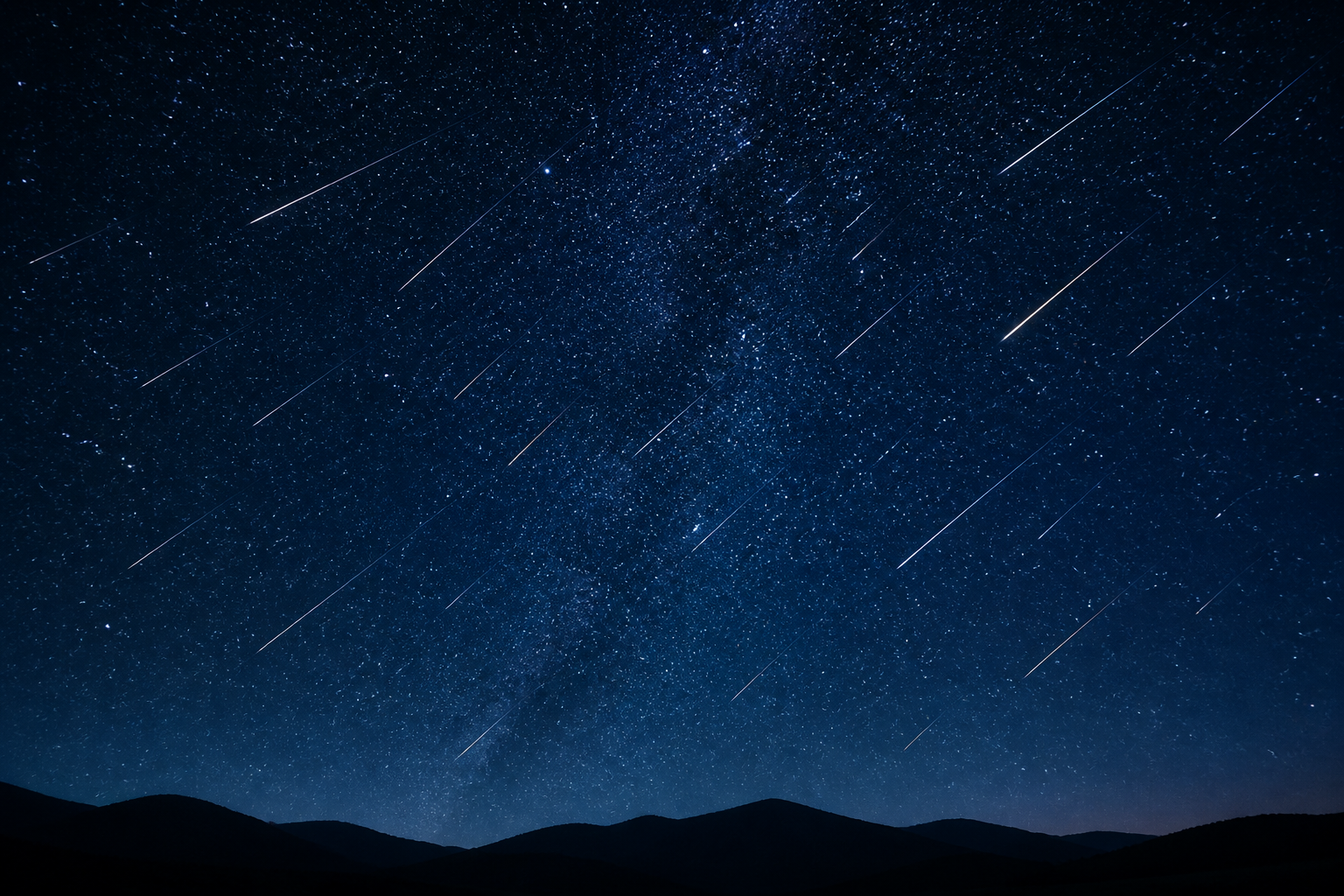
“When is the meteor shower tonight” is trending in the United States because the annual Perseid meteor shower is near its 2026 peak. The best window for many U.S. viewers is late on August 12 into the predawn hours of August 13, though the shower remains active after the mathematical peak. Dark skies around the new moon make the display easier to see than in years when moonlight washes out faint meteors.
Google Trends showed the query as an active U.S. trend during the past 24 hours. That is a measure of unusually high relative interest, not a headcount of viewers or a promise that every location will see the same show. Clouds, local light pollution, horizon obstructions, and the time of night still decide what any one person can see.
Why the Perseids are drawing searches now
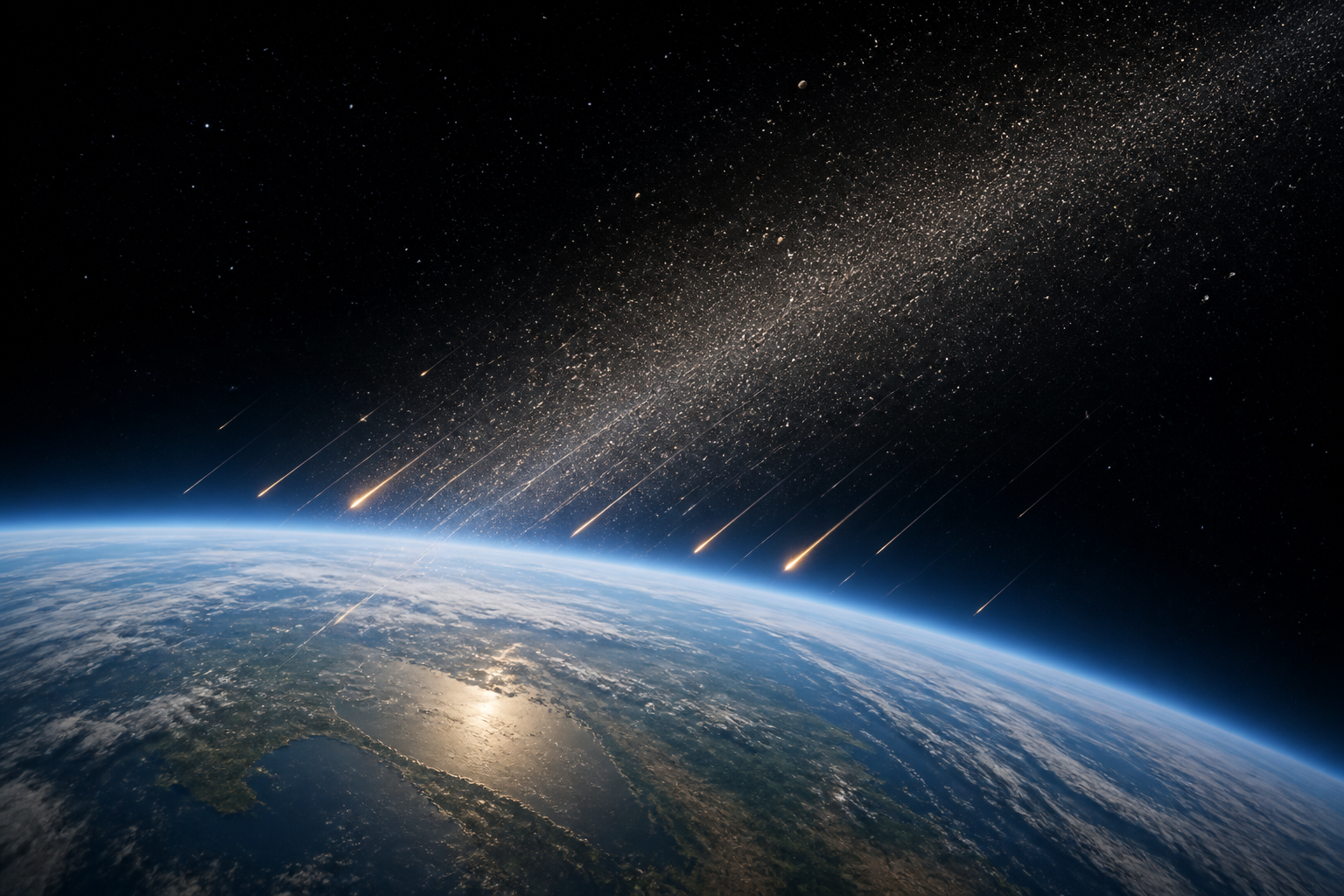
The Perseids return every year as Earth moves through material associated with comet 109P/Swift-Tuttle. Most of the particles are tiny. When they strike the upper atmosphere at high speed, the air around them heats and glows, producing the fast streaks commonly called shooting stars. The apparent point from which their paths spread is the constellation Perseus, which gives the shower its name.
This year’s timing adds two reasons for extra attention. The International Meteor Organization’s 2026 calendar places the Perseid maximum around August 13, with useful activity across surrounding nights. NASA’s 2026 meteoroid-environment forecast also lists a Perseid maximum on August 13. The exact moment is less useful to a casual observer than the practical fact that the radiant climbs higher after midnight and the sky is dark before dawn.
There was another astronomical event on August 12: a total solar eclipse visible along a narrow route through parts of the Northern Hemisphere. It is easy to mix the two events together in a search feed, but they are different. The eclipse was a daytime alignment of the Sun and Moon; the Perseids are an annual nighttime meteor shower. The shared date helped concentrate attention, but the meteor viewing window comes later.
What “peak” really means
A meteor-shower peak is not a switch that flips on for one minute and off the next. It is an estimate of when Earth is moving through a denser portion of a debris stream. Rates can rise and fall over hours, and a local observer’s view can differ sharply from a theoretical forecast.
That is why reports sometimes cite different numbers. NASA’s forecast uses a zenithal hourly rate, or ZHR, which is a modeled ideal: a dark sky, a radiant directly overhead, and an experienced observer watching continuously. The International Meteor Organization’s calendar likewise gives a ZHR for the Perseids. Neither figure is a personal guarantee. AP’s reporting notes that real rural observers may see fewer meteors, even under good conditions.
For a reader deciding whether to go outside, the uncertainty is actually useful. A clear, dark location matters more than chasing a precise hourly number. The shower does not need to produce a headline-grabbing burst to be worth watching; a few bright meteors over an hour can still be the normal, successful experience.
Why the moon matters this year
The peak coincides with a new moon. That does not make more meteors enter the atmosphere, but it reduces a major obstacle to seeing them. Moonlight brightens the background sky, so dim meteors disappear first. A moonless sky gives the eye a better chance to adapt to darkness and detect fainter streaks.
Darkness alone is not enough. City lights, porch lights, and phone screens have the same basic effect: they make the pupil and the eye’s night-sensitive cells work less effectively. A location away from direct light, with a broad view of the sky, is more valuable than specialized gear. The AP’s guide recommends allowing about 30 minutes for eyes to adjust and avoiding the phone screen during that time.
Weather remains the stubborn variable. Forecasts for the shower describe activity above the atmosphere; clouds can erase the view from the ground. If the sky is overcast at the expected peak, a later or earlier clear interval can still be worthwhile because the Perseids are active for weeks, not only on one night.
Where to look, and what not to expect
For Northern Hemisphere viewers, the most productive period is generally between midnight and dawn, when Perseus is higher in the northeastern sky. But there is no need to stare at the constellation itself. Meteors can streak across any part of the sky, so a relaxed view of a large open area is better than aiming at one small point.
Binoculars and a telescope are usually the wrong tools for this particular job because they narrow the field of view. A chair, a blanket, and patience are more practical. The article is not a promise of a spectacular display from every backyard: light pollution can turn a rich shower into an occasional streak, while a rural dark-sky site can reveal many more.
A meteor can also be mistaken for an aircraft, satellite, or the occasional reentering object. Perseids tend to be quick, brief, and appear to trace back toward Perseus when their paths are extended backward. A steady light moving slowly across the sky is more likely a satellite; a blinking light is usually an aircraft. The distinction is part of why a real observation can feel quieter and less dramatic than time-lapse video.
What happens after tonight
The immediate search surge is tied to the peak, the favorable moon phase, and the overlap with the eclipse news cycle. But the Perseid shower does not vanish at dawn. The International Meteor Organization lists its active period through late August, so clear nights after the peak can still produce meteors, even if the rate drops.
The broader lesson is that astronomy trends need a location-and-conditions check. Google Trends can show why a question is suddenly popular; it cannot tell a reader whether clouds cover their sky or how many meteors they personally will see. For that, use an official forecast as a guide, then let the local sky set the expectations.
Sources
- Google Trends Trending Now, United States — confirmation that “when is the meteor shower tonight” was an active U.S. search trend in the past 24 hours.
- NASA Meteoroid Environment Office’s 2026 meteor-shower forecast — forecast timing and idealized zenithal hourly rate for the Perseids.
- International Meteor Organization’s 2026 meteor-shower calendar — activity period, expected maximum, observing context, and the role of the new moon.
- Associated Press guide to the 2026 Perseids — current reporting on viewing conditions, expected real-world rates, and practical observing advice.
Last checked: August 13, 2026, 3:13 PM KST